

Artificial intelligence is no longer knocking at the door of European health care; it is already inside the building. That is the picture painted by “Artificial intelligence is reshaping health systems: state of readiness across the European Union”, a report published by the WHO Regional Office for Europe in 2026. Drawing on a 2024–2025 survey answered by 50 of the 53 countries in the WHO European Region Switzerland among them the report zooms in on the 27 EU member states to ask a simple question: is the region that passed the world’s first comprehensive AI law actually ready to use AI in its hospitals and clinics?
The answer is a qualified “getting there”. And although Switzerland sits outside the EU and therefore outside the report’s scope, almost every finding lands close to home for a country whose health system, medtech industry and research institutions are deeply entangled with the European project.
What the Report Found
On paper, Europe looks well prepared. Some 85% of EU member states (23 of 27) have adopted a cross-sectoral national AI strategy. But only three countries have a strategy specifically for AI in health, and the report warns that broad strategies often lack the health-specific focus needed to translate ambition into safe clinical practice.
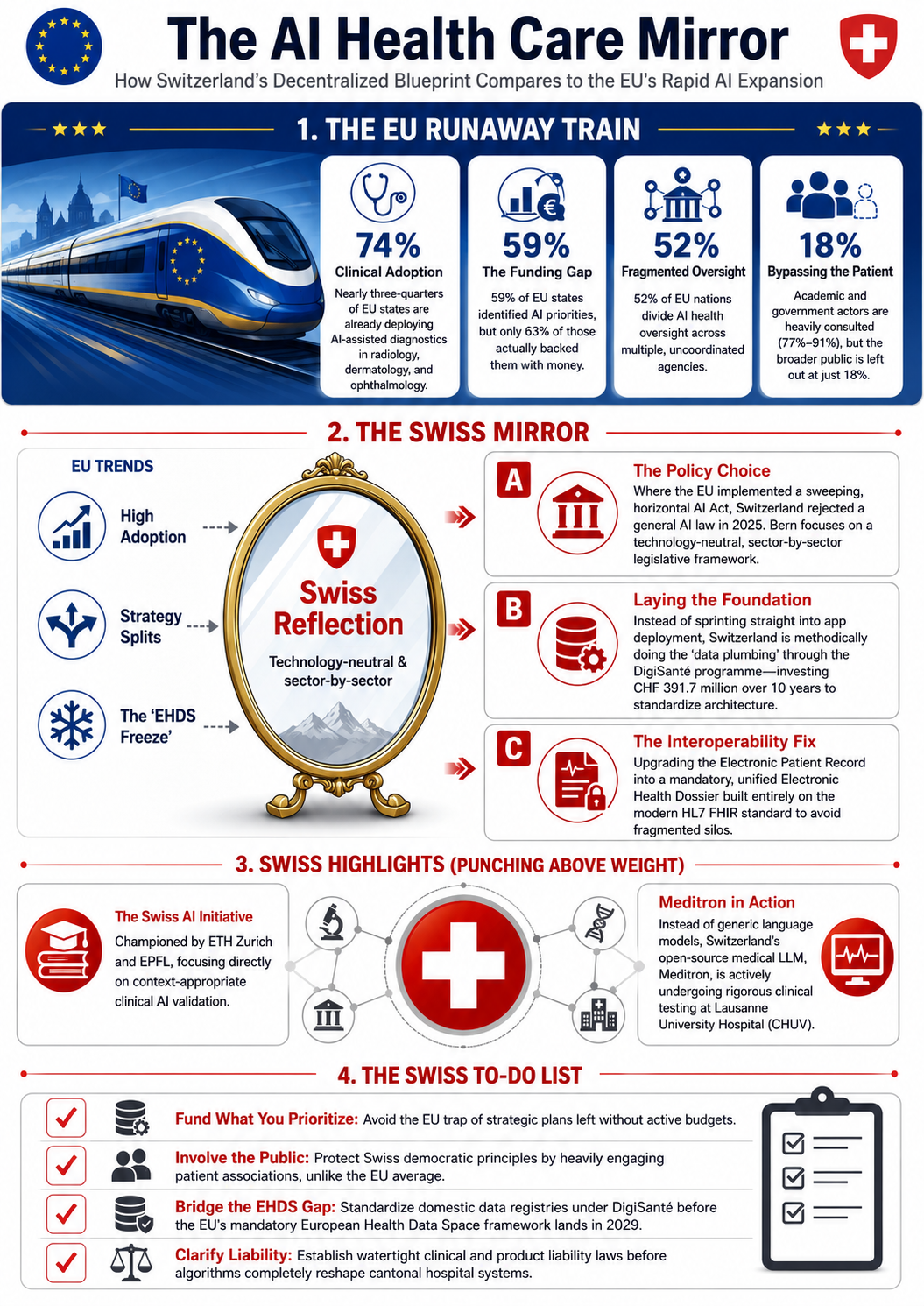
Look at who actually runs these strategies and the picture fragments further. Among countries with a cross-sectoral strategy, 52% (13 of 25) spread oversight across multiple agencies with shared responsibility a model the report warns demands complex coordination and risks regulatory fragmentation. Only 8% (2 of 25) created a new government agency for the job; the vast majority are stretching the mandates of existing authorities rather than building dedicated oversight.
Adoption, meanwhile, is running ahead of governance. Nearly three quarters of EU countries (74%) already use AI-assisted diagnostics, most visibly in radiology, dermatology and ophthalmology, and 63% deploy chatbots for patient assistance. Every single member state named improving patient care as a driver of AI innovation, with easing workforce pressure (96%) and efficiency gains (89%) close behind adoption, in other words, looks driven more by staff strain than by novelty. Yet the sharpest contrast with the wider WHO European Region is not in flashy clinical tools but in the back office: 59% of EU states actively use AI to automate logistics, clerical and administrative tasks, against just 40% region-wide even though only 44% of EU states promote standard requirements for the health data warehouses needed to scale exactly these operational tools.
Breadth of adoption, however, should not be mistaken for maturity. The survey distinguishes between informal use, pilots and “established” use defined as routine deployment in clinical settings for at least two years. By that stricter yardstick the numbers shrink fast: diagnostic imaging AI is established in only 41% of countries, chatbots in 30%, administrative automation in 22%, surgical robotics support in 22%, symptom checkers in 15%, prognosis and risk-prediction tools in just 11%, and remote patient monitoring in a mere 7%. Two caveats apply on top: these are self-reported answers from national coordinators, and “established” says nothing about whether a tool is clinically validated or actually improves outcomes.
The gaps appear once you look beneath the surface:
• Money and follow-through. While 59% of member states have identified priority areas for AI in health, only 63% of those have allocated funding to implement them. Financial affordability was the most frequently cited barrier to adoption (41% rated it of major importance).
• People inside and outside the system. Only 26% of countries offer in-service AI training for health professionals, 22% offer preservice training, and fewer than half have created new professional roles for AI and data science in health. The consultation table is just as lopsided: among the 22 countries that engage stakeholders at all, government actors (91%), health care providers (82%) and academic institutions (77%) dominate, while patient associations are far less frequently consulted and the broader public comes last, at 18% (4 of 22). The report cautions that excluding the very people AI tools are meant to serve undermines trust, context-appropriate design and social acceptance.
• Law and liability. Just two countries have issued guidance on applying existing liability regimes to AI, and only six have published practical guidance on “ethics by design”. Over half of member states see clear liability rules and transparency requirements as the policy levers most likely to unlock trust.
• Data. Two thirds of countries have a health data strategy and 63% run a national health data hub, but only a third have rules for cross-border sharing of health data for research. Much now hinges on the European Health Data Space (EHDS), the EU-wide framework for using and reusing health data that applies from March 2029 and, in an ironic twist, its approach has led some countries to pause or slow their own national data governance initiatives, stalling rather than building for fear of clashing with the mandatory EU-wide rules to come.
Perhaps most striking is the environmental verdict: not a single EU member state rated the environmental impact of AI as a barrier of major importance, and 41% (11 of 27) went further, rating AI’s carbon and water footprint as having no importance at all a policy disconnect the report flags sharply, given the climate-related health risks tied to the energy appetite of large models.
The Swiss Mirror
Switzerland answered the same WHO survey, but its story diverges from Brussels in instructive ways. Where the EU chose a single, horizontal AI Act, the Federal Council decided in February 2025 against a general Swiss AI law. Instead, Switzerland is ratifying the Council of Europe’s AI Convention and pursuing a technology-neutral, sector-by-sector approach, with a bill implementing the convention covering transparency, data protection, non-discrimination and oversight due by the end of 2026. Health care is explicitly on the list of sensitive areas where binding and non-binding measures are being developed.
On digital infrastructure, Switzerland is candid about its late start. The DigiSanté programme, launched in January 2025 with CHF 391.7 million over ten years, bundles roughly 50 federal projects to standardize health data, build national infrastructure and enable secondary use of data for research and planning in effect, the homework many EU states are also being urged to do. In November 2025 the Federal Council moved to replace the country’s struggling electronic patient record with a new Electronic Health Dossier, mandatory for health professionals and built on the HL7 FHIR interoperability standard.
Where Switzerland arguably punches above its weight is research. The Swiss AI Initiative of ETH Zurich and EPFL is turning to specialized medical models, and Meditron, a Swiss-built medical language model, is being tested at Lausanne University Hospital to support clinical decision-making exactly the kind of context-specific, validated AI the WHO report calls for.
The report’s prescriptions also travel well across the border. Among its most concrete proposals are regulatory sandboxes and “assurance laboratories” in leading hospitals controlled environments where AI tools are tested on real workflows with anonymized data before wide deployment and an EU-wide, regularly updated catalogue of verified AI solutions, classified by specialty, performance and operational context. Neither idea requires EU membership to copy. Switzerland’s university hospitals, dense medtech cluster and compact size make it a natural testbed for exactly this kind of supervised experimentation, and a national register of validated clinical AI tools would give cantons and insurers a shared basis for procurement decisions.
Two of the EU’s weaknesses deserve particular attention in Bern. A federal system that divides health competences among 26 cantons is at least as exposed to the “multiple agencies, shared responsibility” fragmentation the report warns about as any EU member state. And for a country whose health policy is regularly decided at the ballot box, the EU’s habit of consulting governments and academics while leaving patients and the public at the margins is a cautionary tale: Swiss AI-in-health policy that skips public engagement risks not just distrust but defeat in a referendum.
Why EU readiness matters in Bern
Three threads tie the report’s findings to Swiss interests. First, market access: Swiss medtech and pharma companies selling AI-enabled products into the EU must comply with the AI Act and the Medical Device Regulation regardless of what Swiss law says. That becomes concrete from August 2026, when the AI Act’s high-risk obligations start to bite for clinical AI such as diagnostics, triage and decision support: systems must be able to show why they made a recommendation, allow clinicians to override it, and come with documented accuracy testing. Swiss hospital procurement teams are reportedly already checking for AI Act conformity even though Switzerland is not bound by the law a quiet, market-driven “Brussels effect” on Swiss health care. Second, data: once the EHDS applies from 2029, the terms on which non-EU researchers and firms can access European health data will matter enormously to a country whose universities and hospitals live off cross-border collaboration and whose own rules for secondary data use are still being written under DigiSanté. The EHDS-induced pause in several EU capitals is itself a signal: whatever Switzerland builds now should be designed for eventual interoperability with the EU framework, not in ignorance of it. Third, the cautionary lessons: the EU’s pattern of strategies without funding, adoption without training, and innovation without liability clarity is precisely the trap a fragmented health system could also fall into.
The WHO report ends with a to-do list for governments: fund what you prioritize, train the workforce, consult the people the tools are meant to serve, clarify who is liable when AI causes harm, and build the data plumbing before the applications arrive. None of those verbs requires EU membership. For Switzerland, watching its neighbours take the world’s most scrutinized regulatory experiment live may turn out to be the cheapest policy research it will ever get provided it acts on what it sees.
Sources: WHO Regional Office for Europe, “Artificial intelligence is reshaping health systems: state of readiness across the European Union” (2026); Swiss Federal Council communications on AI regulation (2025); Federal Office of Public Health, DigiSanté programme; SWI swissinfo.ch reporting on the Swiss AI Initiative (2026); SwissMed AI (mdai.ch), “How Far Has AI Really Spread in European Hospitals?” (June 2026).