Modern medicine provides powerful tools against infections, antibiotics! Despite their strong effect to fight our daily infections, antimicrobial resistance (AMR) has reached a critical global tipping point. According to the World Health Organization (WHO), in 2023 one in six laboratory-confirmed bacterial infections worldwide were resistant to standard antibiotic treatments. Particularly alarming is the rise in resistance among Gram-negative bacteria like Escherichia coli and Klebsiella pneumonie.
Modern medicine provides powerful tools against infections, antibiotics! Despite their strong effect to fight our daily infections, antimicrobial resistance (AMR) has reached a critical global tipping point. According to the World Health Organization (WHO), in 2023 one in six laboratory-confirmed bacterial infections worldwide were resistant to standard antibiotic treatments. Particularly alarming is the rise in resistance among Gram-negative bacteria like Escherichia coli and Klebsiella pneumonie.
The consequences are profound: AMR undermines our ability to treat common infections, threatens major medical procedures (such as surgery, organ transplantation, cancer chemotherapy) and imposes a growing economic burden. Despite this growing crisis, the world hasn’t discovered a truly new type of antibiotic in decades. That is alarming, since the deaths caused by AMR are expected to reach around 39 million people in the next 25 years. Most antibiotics we use today originate from nature and were discovered by isolating compounds from soil bacteria or fungi. This method worked for decades, but has the disadvantage of rediscovery of similar compounds and is a time and resource consuming workflow.
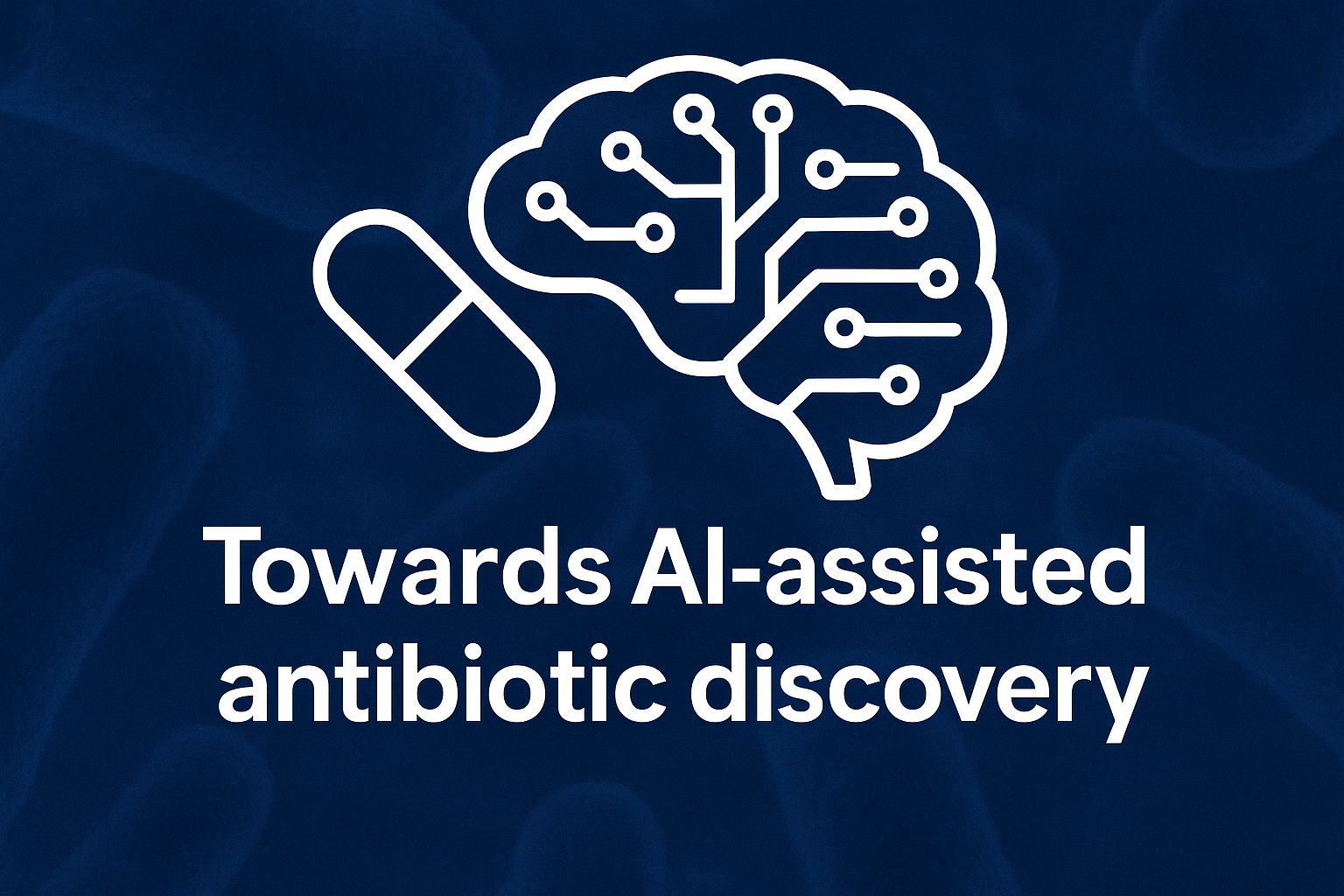
Scientists now are turning to artificial intelligence (AI) to speed up what has long been a slow, expensive, and uncertain process: finding new antibiotics. AI, and especially machine learning (ML), allows computers to analyze massive amounts of data, learn patterns, and make predictions. The more good data it has, the better its predictions become. In antibiotic research, ML models can be trained on the chemical structures of thousands of molecules known to be active (or inactive) against certain bacteria. When shown millions or even billions of new molecules, the model can predict which ones might work.
Instead of digging through soil, scientists can now dig through genetic data, the DNA and protein blueprints of living and extinct organisms. The team around César de la Fuente, Ph.D., a Presidential Associate Professor from the University of Pennsylvania, uses AI to scan this biological data across the entire Tree of Life, searching for small protein fragments (called antimicrobial peptides) that could act like natural antibiotics. They even searched the genomes of extinct species such as Neanderthals and Denisovans discovered peptides that killed the pathogenic bacterium Acinetobacter baumanii. They mined the proteomes of the woolly mammoth, straight-tusked elephant, giant sloth, ancient sea cow and other archaic animals and discovered “mammothisin-1” and “elephasin-2,” which successfully treated infections in mice models.
AI can explore the chemical space using generative models, which learn from known molecules and then create entirely new ones that fit the patterns of effective antibiotics. However, AI sometimes designs molecules that look great digitally but can’t actually be made in the lab. To fix this, Jonathan Stokes and his colleagues from the McMaster University built a model that assembles new molecules from real, ready-to-use chemical building blocks. That ensures every AI-designed compound is not only effective on screen but also synthesizable in real life. Their AI-designed compounds have already shown antibacterial activity in the lab against tough pathogens like Acinetobacter baumannii.
AI’s success also depends on good data. Machine learning models are only as reliable as the information they are trained on. De la Fuente’s team has spent years building high-quality datasets testing thousands of molecules under tightly controlled lab conditions so results are accurate and comparable. In the future, AI could help at every stage of antibiotic development, from predicting whether a drug will succeed in trials to optimizing its safety and delivery. There is a consensus in the scientific community that claims that AI is not a miracle but a tool, that helps towards the solution in the AMR crisis. In other words, AI can help discover and design the antibiotics of the future, but getting those medicines to patients will always depend on human effort, collaboration, and commitment. AI is being used not only to discover new antibiotics but also to detect antibiotic resistance in bacteria by making diagnosis faster and more accurate, setting an advancement in the fight against infections.