

Consumer wearable devices have evolved from lifestyle accessories into clinically relevant physiological monitoring platforms capable of continuously capturing cardiovascular, behavioural, and environmental data. Their established role in atrial fibrillation detection and remote cardiovascular monitoring has prompted a broader question: can wearable-derived physiological signals also quantify complex psychological traits such as resilience? Emerging evidence suggests that heart rate variability (HRV), an established marker of autonomic nervous system function, may represent an important step toward digital phenotyping of psychological health.
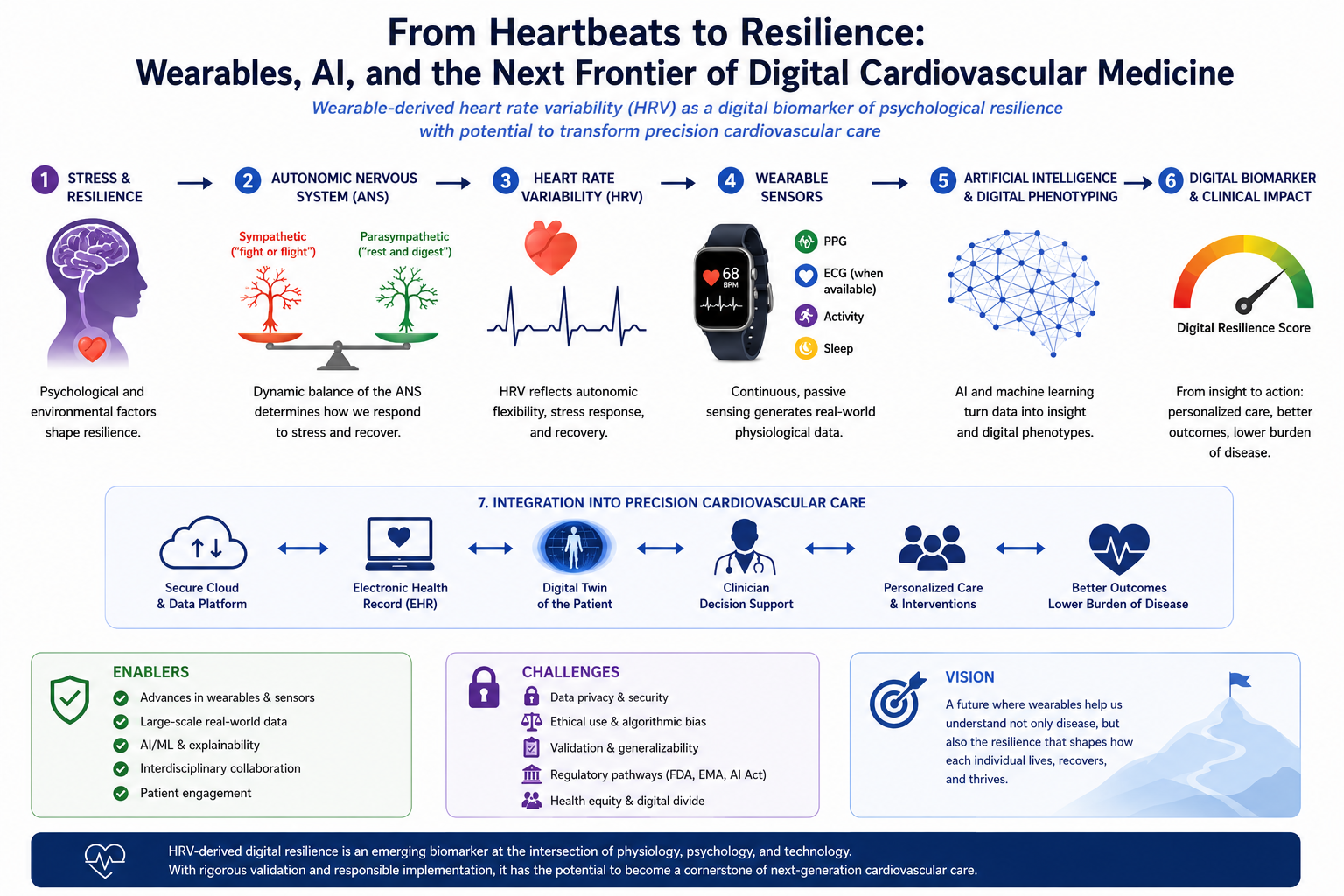
Proposed conceptual framework illustrating the evolution of wearable-derived HRV from a physiological signal to a potential digital biomarker of psychological resilience and its integration into precision cardiovascular medicine. Psychological stressors and resilience interact through autonomic nervous system regulation, generating characteristic HRV patterns that can be continuously captured using consumer wearable devices. Artificial intelligence (AI) and machine-learning algorithms integrate HRV with complementary physiological and behavioural data including physical activity, sleep, and electrocardiographic signals to derive individualized digital resilience profiles. Sleep may be more than one input among many: cardiac autonomic tone is itself strongly sleep-dependent, and insomnia or chronic sleep restriction shifts sympathovagal balance toward sympathetic predominance during both night and day, so a substantial share of the day-to-day variance in HRV plausibly reflects the preceding night’s sleep. Because the same autonomic signature recurs across cardiometabolic and neurological disease, from cardiac autonomic neuropathy in diabetes to the reduced sympathetic activity described in idiopathic REM sleep behaviour disorder and early Parkinson’s disease, wearable-derived sleep architecture may prove at least as informative as HRV alone for resilience profiling. Following rigorous analytical and clinical validation, these digital biomarkers could support cardiovascular metabolic, and neurologic risk stratification, remote patient monitoring, personalized therapeutic interventions, and longitudinal assessment of recovery. Integration with electronic health records and digital twin technologies may further enable individualized clinical decision support. Successful clinical implementation will require robust external validation, explainable AI, regulatory oversight, data privacy protection, and equitable access before wearable-derived resilience can become a clinically actionable component of precision cardiovascular care
A Signal Hiding Between Heartbeats
The fingerprint researchers are following is HRV, a metric that sounds technical but rests on a simple idea. Your heart does not beat like a metronome. Even at rest, the interval between one beat and the next fluctuates by tiny amounts. HRV reflects dynamic interactions between sympathetic and parasympathetic autonomic regulation and represents one of the most extensively studied physiological biomarkers of cardiovascular adaptability. Reduced HRV has consistently been associated with impaired vagal tone, systemic inflammation, frailty, cardiovascular mortality, and adverse outcomes across multiple cardiac populations, including heart failure, myocardial infarction, atrial fibrillation, and hypertension. These observations have positioned HRV as a promising candidate digital biomarker capable of linking cardiovascular physiology with behavioural and psychological adaptation.
That flexibility is really a window onto the autonomic nervous system, the automatic control layer that governs how you meet a stressor and how you recover afterward. One branch, the sympathetic system, revs you up for a challenge the other, the parasympathetic, brings you back down once the threat passes. A nimble autonomic nervous system can accelerate and decelerate your heart rate smoothly in response to whatever the day throws at you. HRV, in effect, is a readout of how nimble that system is and modern smartwatches can capture it without any special effort from the wearer.
Hirten and Fayad's hypothesis builds directly on that link. If HRV reflects how adaptable your nervous system is, and if resilience is fundamentally about adapting to adversity, then the two oughts to be related. People who bounce back from stressful events, the reasoning goes, should tend to show the fluid autonomic function that healthy HRV signals.
From Hunch to Data
The idea did not arrive out of nowhere. In earlier work, the team of Hirten and Fayad reported group-level associations between HRV patterns and self-reported resilience, drawing on a 2020 dataset. "If we look at HRV measurements, we are able to differentiate degrees of psychological resilience," Hirten says. Dr. Xhigoli an experienced psychotherapist in Bern (Switzerland) frames resilience as more than a feel-good trait. "Resilience is an important thing, because it demonstrates a person's ability to deal with adversity and stressful events. It's particularly important in chronic disease management, where building resilience has been shown to improve long-term outcomes in chronic diseases."
This need for richer, contextual data is also the direction pursued by Callisia startup, a wearable technology platform being developed to combine optical pulse sensing for HRV with motion and temperature measurements. By accounting for factors such as physical activity, sleep, recovery and physiological state, Callisia aims to make HRV trends more interpretable and useful for personalised stress and recovery insights while recognising that HRV is a supportive physiological marker, not a standalone diagnosis of resilience or mental health.
Newer studies push the question further. The researchers paired standardized psychological measurements with HRV data tracked over time for each participant. For the psychological side, they leaned on the Connor-Davidson Resilience Scale, a well-established questionnaire. Then they built a suite of machine learning models and set them a task: predict, from a person's HRV patterns alone, both their resilience and a combined score blending resilience, optimism, and emotional support.
The reported AUC values (0.60–0.65) are encouraging but remain insufficient for individual-level clinical decision-making. Rather than accurately identifying resilience in a single person, current models capture a group-level physiological signature associated with psychological adaptation. Translating this association into robust, individualized prediction remains the critical next step for digital phenotyping.
The team is candid about that gap. They describe the study as a proof of concept and note that it was a retrospective analysis, mining a dataset gathered for other purposes rather than an experiment designed from the outset to measure individual resilience. Their next studies aim to fix that. The original 2020 data came from the Warrior Watch project and ordinary consumer smartwatches; now the researchers want richer inputs. "We're using different devices where we can get more raw data which we can translate into multiple HRV measurements," Hirten says. "We can then relate this much richer dataset to psychological assessments or chronic disease outcomes."
The Promise, and the Questions it Raises
What the researchers see on the horizon is a more accessible kind of mental health care one that meets people through the devices already on their wrists. They imagine wearable data flowing into the clinical system, helping sort patients and target support. "We can link a patient's wearable to their chart, and we can identify which groups are more or less resilient," Fayad says. He extends the vision to crisis settings and to clinicians themselves: "In the context of a pandemic, we know that more resilient people will be able to hang on. We can use this information for triage and training as well, to see which doctors don't have that resilience." Eventually, Fayad suggests, heart rate variability-derived assessments might help both patients and physicians build resilience rather than merely measure it.
That vision is genuinely appealing, and it is also where the caution belongs. Using a wrist sensor to decide who gets scarce attention or to flag which doctors are running low on the capacity to cope turns a modest statistical signal into a consequential judgment. A model that is right roughly six times out of ten is a fine starting point for research and a shaky foundation for triage. The distance between "correlated at the group level" and "trustworthy for an individual" is exactly the distance the team says its future work must cover.
For now, the honest headline is smaller than the ambition: a physiological signal your smartwatch already collects carries a faint, detectable trace of psychological resilience. Whether that trace can ever be read reliably enough to act on at arm's length, from a device you bought for counting steps remains an open and important question.
Where the Science Stands in 2026
In 2023, the Mount Sinai team shared their research in the Journal of the American Medical Informatics Association (JAMIA) Open. Rather than offering a final conclusion, that initial 2023 study marked a starting point, and the ensuing three years have brought to light both the opportunities and the limitations of the technology.
The most direct follow-up echoes the Mount Sinai thesis and its limits at once. A 2025 study set out to predict positive psychological states self-esteem, positive affect, a sense of meaning from everyday wearable data, exactly the direction Hirten and Fayad said they wanted to pursue. It hit a familiar ceiling: the best models reached roughly 62% accuracy. More tellingly, movement data from the accelerometer often out-predicted HRV, and self-esteem showed the clearest bodily signature of all the states tested. That hints the richest signal may not live in the heartbeat alone.
Meanwhile, the broader concept has hardened into a framework. A 2026 review recasts HRV as a "dual-use digital biomarker" bridging clinical medicine and operational settings such as the military and emergency response, treating shifts in HRV as a quantifiable index of resilience that can separate people who sustain performance under load from those nearing exhaustion. Military evidence shows that continuous HRV monitoring tracks real-time adaptation to exertion, sleep loss, and stress. During prolonged exercises, nocturnal HRV drops as cumulative strain builds, often alerting command to these autonomic changes before performance declines or clinical symptoms appear. That is essentially the triage-and-training vision Fayad described, now written up as a cross-sector blueprint. The adjacent problem of detecting acute states has advanced further still: recent models report high accuracy for stress detection, anxiety-state prediction using deep learning, and depression screening from HRV. Catching a passing state, though, is an easier task than reading a stable trait like resilience.
The caveats have sharpened just as much. Two 2025 systematic reviews are blunt about the field's weaknesses: most studies rest on small samples; one review found roughly three-quarters had fewer than 100 participants along with monitoring windows shorter than a week, almost no external validation, and thin attention to data privacy. Headline accuracy figures are often inflated by methodological shortcuts, and the researchers who apply the most rigorous methods tend to report lower but more trustworthy numbers. In other words, the very gap the Mount Sinai team named in 2023 between a group-level correlation and a verdict you would trust about one individual remains the field's central unsolved problem in 2026.
A sweeping 2026 umbrella review in Physiological Reviews, pooling 39 systematic reviews and 98 studies, puts all of this in sobering perspective. Its clearest finding is that wrist wearables reliably get people moving more; their effect on step counts and overall activity is the strongest and most consistent benefit. But once you look past physical activity, the evidence thins dramatically: effects on cardiometabolic markers, quality of life, and especially depression, anxiety, and pain were limited and inconsistent. The reviewers also judged most of the underlying research low quality, with only about 15 percent of the systematic reviews earning high-confidence ratings, and they found wearables tend to work best when paired with coaching or lifestyle change rather than used alone. In other words, the domain where wearables have most convincingly proven their worth is behavior, not the inner psychological life the resilience work hopes to reach.
So the picture that emerges is neither hype nor dismissal. The idea that a wrist device carries a real, if faint, imprint of psychological resilience has survived three years of scrutiny and is being scaled toward clinical and operational use. But the reasons for caution: modest accuracy, small studies, weak validation, and the ethical weight of acting on any of it have grown clearer, not fainter.
Consumer wearables have already transformed cardiovascular rhythm monitoring and remote patient surveillance. Their next evolution may be considerably more ambitious not merely detecting disease but quantifying an individual's capacity to physiologically adapt to stress. Whether wearable-derived resilience ultimately becomes a clinically actionable digital biomarker will depend on rigorous validation, transparent artificial intelligence, equitable implementation, and prospective demonstration of clinical utility. Until then, resilience should be regarded as one of the most promising but still exploratory frontiers in digital cardiovascular medicine.
Sources
1. Hirten RP, Suprun M, Danieletto M, Zweig M, et al. A machine learning approach to determine resilience utilizing wearable device data: analysis of an observational cohort. JAMIA Open, 2023.
2. Heart rate variability as a dual-use digital biomarker: integrating clinical, AI, and operational perspectives on human performance and resilience. BMC Cardiovascular Disorders, 2026.
3. Pataca AO, et al. Use of machine learning for predicting stress episodes based on wearable sensor data: A systematic review. Computers in Biology and Medicine, 2025.
4. Wu L, et al. Predicting Positive Psychological States using Machine Learning and Digital Biomarkers from Everyday Wearable Data. 2025.
5. Shen S, et al. Passive Sensing for Mental Health Monitoring Using Machine Learning With Wearables and Smartphones: Scoping Review. Journal of Medical Internet Research, 2025.
6. Bahameish MA, et al. Strategies for Reliable Stress Recognition: A Machine Learning Approach Using Heart Rate Variability Features. Sensors, 2024.
7. Gu X, et al. Research on mood monitoring and intervention for anxiety disorder patients based on deep learning wearable devices. Technology and Health Care, 2025.
8. Yang M, et al. Auxiliary identification of depression patients using interpretable machine learning models based on heart rate variability: a retrospective study. BMC Psychiatry, 2024.
9. Glisic M, Llane A, Stojic S, et al. An umbrella review of systematic reviews of the impact of wrist-worn wearables on health outcomes. Physiological Reviews, 2026.
10. Glisic M, Llane A, Stojic S, et al. An umbrella review of systematic reviews of the impact of wrist-worn wearables on health outcomes. Physiological Reviews, 2026.
11. Oka, H. (2017). Heart Rate Variability and Neurological Disorders. In Clinical Assessment of the Autonomic Nervous System (pp. 179-197). Springer, Tokyo. https://doi.org/10.1007/978-4-431-56012-8_11
12. Trivedi, G. Y. (2019). Can decreased heart rate variability be a marker of autonomic dysfunction, metabolic syndrome and diabetes? Journal of Diabetology, 10(2), 48. https://doi.org/10.4103/jod.jod_17_18,