

Menstruation is a natural biological process experienced by over 1.8 billion people worldwide. Despite its widespread prevalence, menstrual blood has long been overlooked in medical diagnostics. However, recent advancements in technology are changing this perspective. Researchers at ETH Zurich (Eidgenössische Technische Hochschule) have developed MenstruAI, a groundbreaking system that transforms sanitary pads into diagnostic tools capable of detecting disease biomarkers in menstrual blood. This innovation not only empowers individuals to monitor their health discreetly but also paves the way for more accessible and personalized healthcare solutions. “Some years ago, we realized that menstrual blood was a source of health information that was really underutilized,” said Lucas Dosnon, a graduate student in medical materials innovation researcher Inge Herrmann’s lab at ETH
The Technology Behind MenstruAI
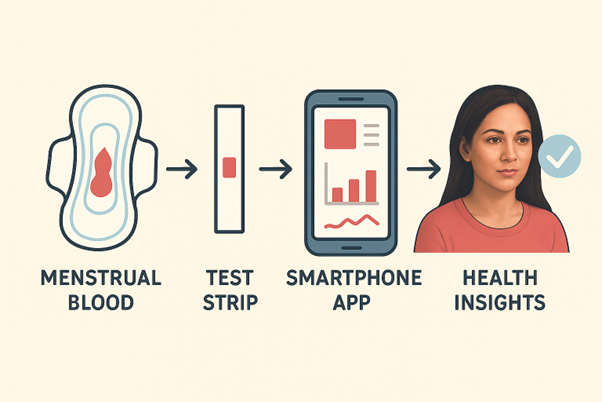
MenstruAI uses a lateral flow assay, like home COVID-19 detection kits. The test strip, embedded inside the pad, contains antibodies that react with specific biomarkers present in menstrual blood. Upon contact, a color change occurs, indicating the presence and concentration of these biomarkers. To ensure accurate and consistent results, the researchers designed a soft silicone microfluidic sheath that controls the volume of blood reaching the sensor. This design prevents staining and ensures that only a controlled amount of blood interacts with the test strip, increasing the reliability of the results.
"MenstruAI has the potential to transform women’s health by providing a non-invasive, affordable, and accessible way to monitor well-being-promoting equitable, inclusive, and widespread access to healthcare,” the researchers stated.
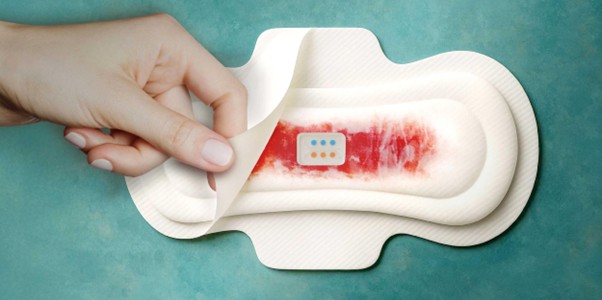
The sensors shift colour, visible either to the naked eye or through a smartphone app, when they detect disease biomarkers, indicating if medical consultation may be needed. In a proof-of-concept study published in Advanced Science, researchers demonstrated that this platform could serve as an accessible and non-invasive method for monitoring health among menstruators [5].
Menstrual blood as a window to health
Recent scientific discoveries have shown that the proteins and biomarkers present in menstrual blood closely mirror those found in venous blood. Researchers have used this knowledge to measure glycated hemoglobin in individuals with diabetes, to detect human papillomavirus (HPV), a leading cause of cervical cancer and to identify biomarkers associated with endometriosis [6, 7]. When Hermann first considered the idea of detecting biomarkers directly from menstrual blood collected on a sanitary pad, she was sceptical. “I assumed this must have already been explored,” she said. But after thoroughly reviewing the scientific literature, she realized there was a gap: although some studies had examined dried menstrual blood from sanitary napkins, they all required extracting and processing the samples in a laboratory environment. Driven to develop a more accessible and user-friendly method that eliminated the need for laboratory processing, Hermann searched for existing technologies but came up empty. This discovery reinforced her belief that her team was venturing into uncharted territory.
Role of Artificial Intelligence
Although the test strip offers a visual cue indicating the presence of biomarkers, subtle color variations can be difficult to interpret accurately. That’s where artificial intelligence (AI) comes in. The MenstruAI system features a smartphone application powered by an AI-driven algorithm trained on hundreds of test strip images. By analyzing color intensity and pattern, the app quantifies biomarker levels and translates them into clear, actionable health insights. This AI integration not only improves the precision of readings but also enables personalized health monitoring. Users can track biomarker trends over time, supporting early detection of potential health concerns and promoting timely medical intervention.
Biomarkers Detected by MenstruAI
MenstruAI is built to identify key biomarkers linked to a range of health conditions:
- ● C-Reactive Protein (CRP): Increased CRP levels signal inflammation, which may point to infections or chronic diseases.
- ● Carcinoembryonic Antigen (CEA): Elevated CEA levels are commonly linked to certain cancers, such as ovarian and colorectal cancer.
- ● Cancer Antigen 125 (CA-125):High CA-125 concentrations can indicate ovarian cancer or endometriosis.
Implications for Women's Health
The development of MenstruAI represents a significant advancement in women's health. Traditionally, menstrual blood has been considered waste, with little attention given to its potential as a diagnostic tool. By harnessing the information contained in menstrual blood, MenstruAI empowers individuals to monitor their health discreetly and conveniently. This innovation also addresses a critical gap in healthcare accessibility. Many individuals face barriers to regular medical check-ups due to time constraints, financial limitations, or lack of access to healthcare facilities. MenstruAI offers a non-invasive, cost-effective solution that can be used at home, reducing the need for frequent doctor visits and enabling continuous health monitoring.
Moreover, the integration of AI allows for personalized health insights, enabling users to track changes over time and make informed decisions about their health. This data-driven approach fosters a proactive mindset toward health management, encouraging individuals to seek medical advice when necessary and adhere to preventive measures.
Challenges and Future Directions
While MenstruAI holds great promise, several challenges must be addressed to realize its full potential. One of the primary concerns is the variability of menstrual blood. Factors such as diet, stress, and hormonal fluctuations can affect the composition of menstrual blood, potentially influencing biomarker levels. Establishing standardized reference ranges for biomarkers in menstrual blood is essential to ensure accurate interpretation of results. Additionally, further research is needed to validate the long-term effectiveness and reliability of MenstruAI. Large-scale clinical trials will be necessary to assess the system's performance across diverse populations and various health conditions.
The regulatory landscape also poses challenges. As a novel medical device, MenstruAI must undergo rigorous testing and approval processes to ensure its safety and efficacy. Collaborations with regulatory bodies and adherence to international standards will be crucial in bringing this technology to market.
References:
- 1. Dosnon, L.e.a.A.W.I.-P.D.f.t.D.o.D.B.i.M.B.A.S.
- 2. Jennifer Kotler, P.A.s.h.o.m.m.p.
- 3. BI-Ehealthcare, T.E.o.M.P.A.J.T.T.w.
- 4. Deborah Kyburz, S.t.m.i.t.s.
- 5. Dosnon, L., et al., A Wearable In-Pad Diagnostic for the Detection of Disease Biomarkers in Menstruation Blood. Advanced Science, 2025. 12(32): p. e05170.
- 6. Naseri, S., R.C.L. Brewster, and P.D. Blumenthal, Novel use of menstrual blood for monitoring glycaemic control in patients with diabetes: a proof-of-concept study. BMJ Sex Reprod Health, 2022. 48(2): p. 123-127.
- 7. Naseri, S., et al., Screening for High-Risk Human Papillomavirus Using Passive, Self-Collected Menstrual Blood. Obstet Gynecol, 2022. 140(3): p. 470-476.