Connect. Collaborate. Grow.
Connect. Collaborate. Grow.
Author: Gjylije Hoti
Alfred Nobel envisioned science as a means to improve society through knowledge and humanism. Since 1901, the Nobel Prize in Chemistry has recognized discoveries that have profoundly benefited humankind, from uncovering the laws of molecular behavior to designing materials that reshape our world. Beyond prestige, the Nobel Prize carries institutional influence: it shapes university rankings, attracts talent, and enhances research visibility, reinforcing its role as a benchmark of global scientific excellence.
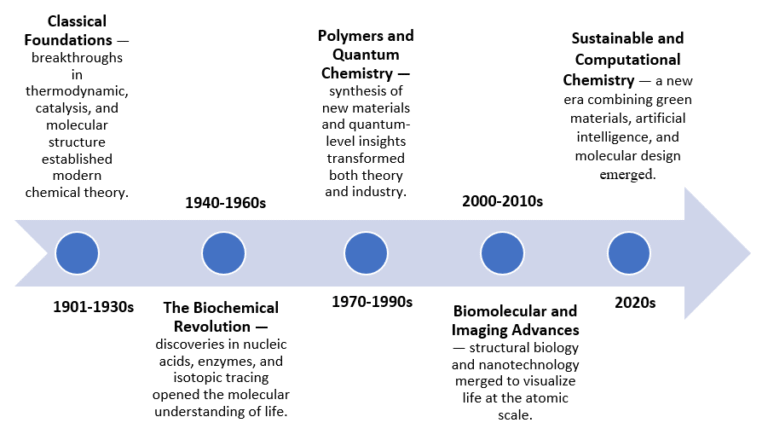
Over more than a century, the Nobel Prize in Chemistry has mirrored the evolution of the field itself.
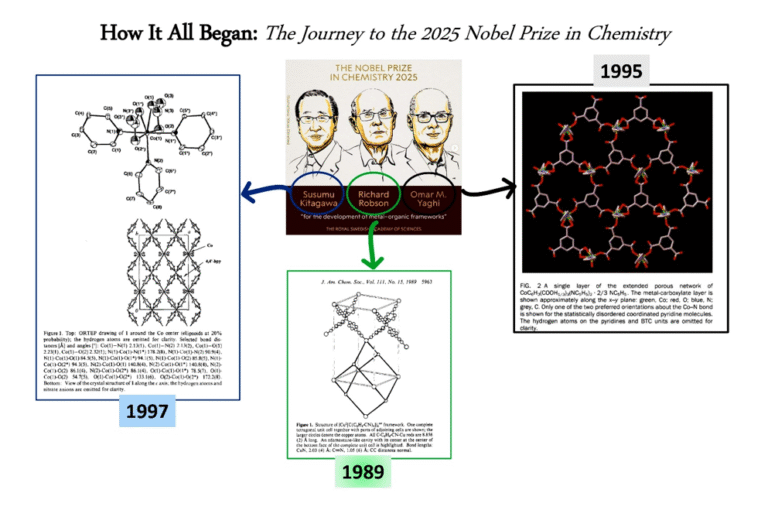
After highlighting the century-long evolution of chemistry and the Nobel Prize’s role in recognizing transformative discoveries, the discussion naturally leads to the latest milestone: Metal–Organic Frameworks (MOFs). This year’s Nobel Prize in Chemistry honors Susumu Kitagawa (Kyoto University, Japan), Richard Robson (University of Melbourne, Australia), and Omar M. Yaghi (University of California, Berkeley, USA) for the development of metal–organic frameworks (MOFs).
MOFs combine metal nodes and organic linkers to create crystalline (Figure 1), highly porous, sponge-like structures with surface areas extending 6,000 m²/g. Their well-defined atomic architecture allows precise correlation between structure and function, while the advanced chemistry of their components enables the design of materials with tailored functionality and performance. By uniting organic and inorganic chemistry, MOFs offer unprecedented control over composition, porosity, and properties, driving the development of next-generation materials and opening new frontiers in synthetic chemistry [1]–[4]. Their development illustrates how fundamental scientific curiosity—from Robson’s diamond-inspired porous crystals [5], Kitagawa’s flexible frameworks [6], to Yaghi’s customizable MOFs [7]—can evolve into materials with transformative real-world applications.
By situating MOFs within this historical and scientific context, we can appreciate not only their immediate technological significance but also their role as a model for future chemistry, bridging molecular design, material engineering, and sustainability.
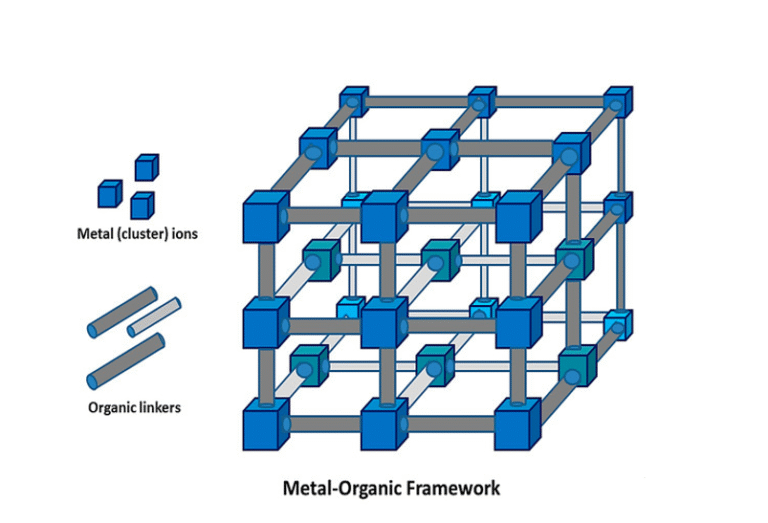
Figure 1. Schematic representation of the three-dimensional arrangement of metal-organic frameworks (MOFs), highlighting the coordination between metal nodes and organic linkers that defines their composition.
Since the 1990s, the field of MOFs has experienced remarkable and nearly unparalleled growth. This expansion is evidenced by the exponential increase in the number of publications over the years (Figure 2).
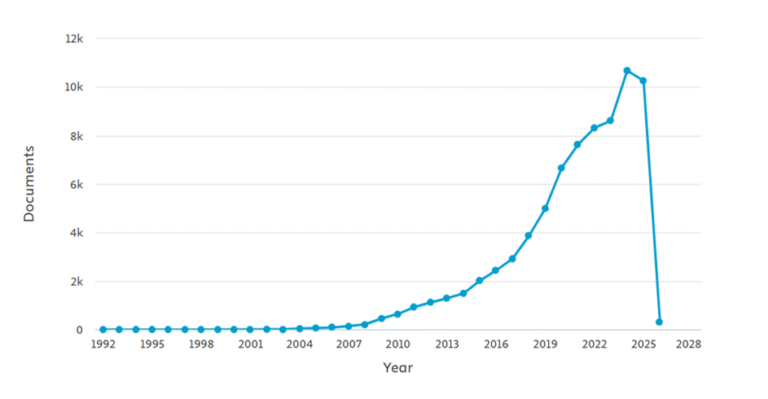
Figure 2. Growth trend of scientific publications related to MOFs over the years. Scopus: KEY (metal AND organic AND frameworks).
Since their discovery in 1999, MOFs have rapidly evolved, with new structures emerging almost daily. Based on the environmental characteristics of their components, MOFs can be classified as special metals–special ligands, green metals–special ligands, and green metals–green ligands, the latter being most relevant for sustainable production. Environmentally benign MOFs typically employ abundant, low-toxicity metals such as Bi, Mg, Al, Ca, Zn, Fe, Zr, and Ti [8]. Rooted in classical coordination chemistry concepts introduced by Alfred Werner, MOF research has progressed from amorphous coordination polymers to stable, crystalline materials, advancing toward greener and more sustainable synthesis strategies [9].
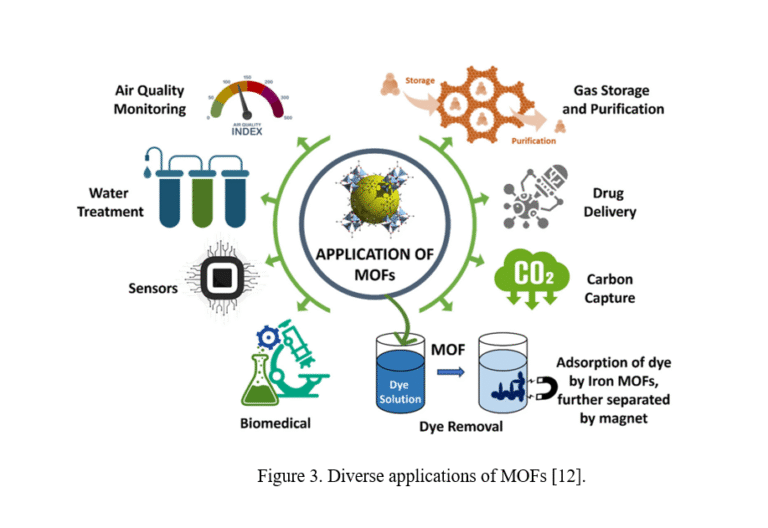
Their exceptional porosity and chemical versatility make MOFs promising for diverse applications, including CO₂ capture, water harvesting, gas storage, catalysis, molecular separation, sensing, energy storage, drug delivery, and environmental remediation (Figure 3) [10], [11].
First developed by Omar Yaghi in 1995 [7], MOFs are permanently porous, allowing them to trap gases like hydrogen, methane, carbon dioxide, and even water. Today, more than 100,000 MOF types are known [13]. For Yaghi, MOFs are among the most important materials in chemistry, not just because of their record-breaking porosity, but because they represent a whole new way of designing matter. Through reticular chemistry, MOFs unite organic and inorganic chemistry, combining creativity, structure, and sustainability to solve real-world challenges such as water scarcity and environmental pollution (Innovation & Tech Today, 2025). The 2025 Nobel Prize marks more than the recognition of an extraordinary material, it celebrates a philosophy of chemistry that combines creativity, structure, and sustainability. MOFs mark a century-long evolution from molecular studies to the creation of advanced materials shaping a sustainable future. MOFs have established an innovation cycle that connects molecular design, material engineering, and device integration, enabling impactful applications such as carbon capture and water harvesting. The rise of digital reticular chemistry and AI-driven computational methods now accelerates the prediction and optimization of new MOF structures. Future progress lies in sustainable large-scale synthesis, hybrid MOF composites with polymers or proteins, and expanded roles in energy, environmental remediation, and biomedical applications, bridging chemistry, engineering, and digital science for global benefit (Figure 4) [14].
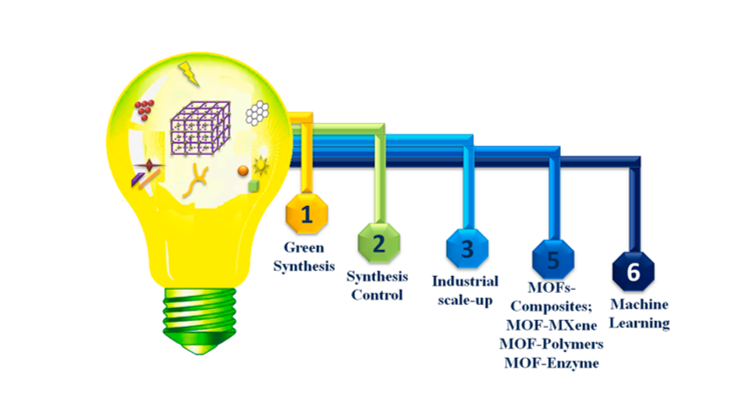
Figure 4. A schematic illustration of future MOF’s perspectives [15].
References
[1] H. Furukawa, K. E. Cordova, M. O’Keeffe, and O. M. Yaghi, “The Chemistry and Applications of Metal-Organic Frameworks,” Science (80-. )., vol. 341, no. 6149, pp. 1–12, 2013.
[2] J. R. Long and O. M. Yaghi, “The pervasive chemistry of metal-organic frameworks,” Chem. Soc. Rev., vol. 38, no. 5, pp. 1213–1214, 2009.
[3] H.-C. Zhou, J. R. LONG, and O. M. Yaghi, “Introduction to Metal − Organic Frameworks,” Chem. Rev., vol. 112, pp. 673–674, 2012.
[4] P. A. Sampaio et al., “A Review on Metal–Organic Frameworks as Technological Excipients: Synthesis, Characterization, Toxicity, and Application in Drug Delivery Systems,” Compounds, vol. 5, no. 1, pp. 1–28, 2025.
[5] B. F. Hoskins and R. Robson, “Infinite Polymeric Frameworks Consisting of Three Dimensionally Linked Rod-like Segments,” J. Am. Chem. Soc., vol. 111, no. 15, pp. 5962–5964, 1989.
[6] M. Kondo, T. Yoshitomi, K. Seki, H. Matsuzaka, and S. Kitagawa, “Three-Dimensional Framework with Channeling Cavities for Small Molecules: {[M2(4, 4′-bpy)3(NO3)4]·xH2O}n (M Co, Ni, Zn)†,” Angew. Chem. Int. Ed. Engl., vol. 16, no. 36, pp. 1725–1727, 1997.
[7] 0. M. Yaghi, Guangming Li, and Hailian Li, “Selective binding and removal of guests in a microporous metal-organic framework,” Nature, vol. 378, pp. 703–706, 1995.
[8] Q. He, F. Zhan, H. Wang, W. Xu, H. Wang, and L. Chen, “Recent progress of industrial preparation of metal–organic frameworks: synthesis strategies and outlook,” Mater. Today Sustain., vol. 17, pp. 1-.27, 2022.
[9] K. O. Kirlikovali, S. L. Hanna, F. A. Son, and O. K. Farha, “Back to the Basics: Developing Advanced Metal-Organic Frameworks Using Fundamental Chemistry Concepts,” ACS Nanosci. Au, vol. 3, no. 1, pp. 37–45, 2023.
[10] X. Han, W. Zhang, Z. Chen, Y. Liu, and Y. Cui, “The future of metal-organic frameworks and covalent organic frameworks: rational synthesis and customized applications,” Mater. Horizons, vol. 10, no. 12, pp. 5337–5342, 2023.
[11] Z. Di, Y. Qi, X. Yu, and F. Hu, “The Progress of Metal-Organic Framework for Boosting CO2 Conversion,” Catalysts, vol. 12, no. 12, pp. 1–17, 2022.
[12] S. Singh, N. Sivaram, B. Nath, N. A. Khan, J. Singh, and P. C. Ramamurthy, “Metal organic frameworks for wastewater treatment, renewable energy and circular economy contributions,” npj Clean Water, vol. 7, no. 1, 2024.
[13] S. Majumdar, S. M. Moosavi, K. M. Jablonka, D. Ongari, and B. Smit, “Diversifying Databases of Metal Organic Frameworks for High-Throughput Computational Screening,” ACS Appl. Mater. Interfaces, vol. 13, no. 51, pp. 61004–61014, 2021.
[14] L. Gagliardi and O. M. Yaghi, “Three Future Directions for Metal-Organic Frameworks,” Chem. Mater., vol. 35, no. 15, pp. 5711–5712, 2023.
[15] F. zohra Zeggai, Z. Ait-Touchente, K. Bachari, and A. Elaissari, “Investigation of Metal-Organic Frameworks ( MOFs): Synthesis, Properties, and Applications – An In-Depth Review,” Chem. Phys. Impact, vol. 10, pp. 1–29, 2025.
Download our App and get extra AI help. Hurry Up!!


Copyright © 2025 Phdcircle. All rights reserved.