
From Pandemic Pressure to Predictive Care:
How Callisia Health Is Rethinking Continuous Monitoring
What happens when engineers, healthcare professionals, and data scientists come together during a global health crisis with one shared realization: too much critical patient information is slipping through the cracks?
For the founders of Callisia Health, that realization became the starting point of a mission to transform how patients are monitored — not only in hospitals, but in everyday life
Born during the early days of COVID-19, the startup initially focused on helping identify early warning signs in patients at risk of developing severe symptoms. In hospital wards, the urgent need for continuous and remote patient monitoring became increasingly clear. Clinical deterioration often went unnoticed for hours, delaying intervention and increasing risks for patients. Motivated by this challenge, the founders set out to create a wearable biosensor platform powered by artificial intelligence that could provide real-time monitoring and early prediction of health risks.
By combining wearable technology with continuous health monitoring, the team quickly realized they were building something much larger than a single pandemic solution.
We realized that valuable patient information was constantly being lost between observation and action,” explained the company’s CEO during our interview. “Healthcare teams often rely on fragmented snapshots instead of continuous, real-time insights.”
That realization became the foundation of Callisia Health.
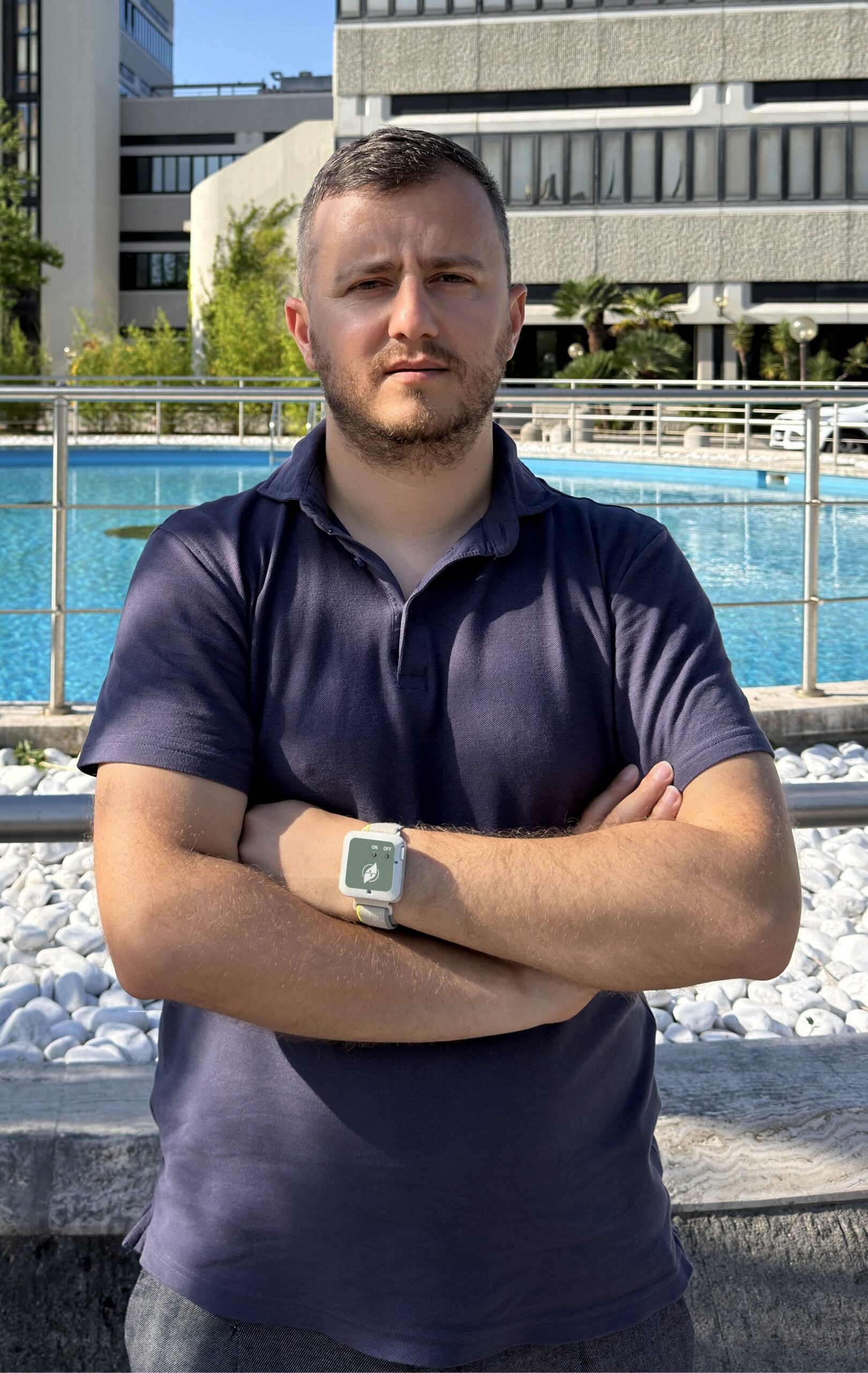
Behind the company is CEO and founding engineer Dianel Ago, whose journey into healthcare innovation started long before the company itself. With a background in Computer Science and Automation from Marche Polytechnic University, Ago now leads the development of Callisia's real-time patient monitoring platform, combining wearable biosensors, predictive AI, and secure digital healthcare infrastructure.
Yet the origins of his interest in technology were much simpler.
Ago describes childhood curiosity as the beginning of everything. Long before building healthcare platforms, he spent time dismantling and rebuilding gadgets simply to understand how they worked. As a teenager, curiosity evolved into experimentation with mobile web pages, advertisements, and early app development projects. What started as a fascination with understanding systems gradually developed into a drive to create technology with real-world impact.
Today, that same mindset continues to shape the company.
Beyond Fitness Wearables
While consumer smartwatches and fitness trackers have become increasingly common, Callisia Health wanted to build something fundamentally different: a clinically relevant monitoring platform designed to support healthcare professionals, caregivers, and patients alike.
Their system combines clinical-grade wearable sensors with artificial intelligence and predictive analytics, helping clinicians identify risks earlier and respond faster.
Founded in 2023 as an academic spin-off connected to Università Politecnica delle Marche, Callisia rapidly expanded by bringing together expertise from AI, medical hardware, software engineering, and cybersecurity. The startup's interdisciplinary roots play a major role in its approach.
The team includes engineers, healthcare professionals, and AI researchers — including university professors who had been working on predictive healthcare models long before AI became a mainstream topic.
“Our vision was not just to build technology for its own sake,” the founder shared. “We are talking about a true continuous monitoring that can be accessible and human-centered.”
An interesting strength of the company lies in something many people might not immediately expect. The team has developed the ability to build advanced predictive AI systems and cybersecurity architectures almost entirely in-house, from hardware manufacturing to algorithm development and cloud integration. This end-to-end capability allows them to deliver highly personalized healthcare solutions while maintaining strong control over security and patient privacy.
Building Healthcare Technology in the Real World
Turning a promising idea into a healthcare startup, however, is rarely straightforward.
Like many health-tech innovators, Callisia Health quickly discovered that building the technology itself was only one part of the challenge. Trust, clinical validation, regulation, usability, and integration into healthcare workflows proved equally important.
One major turning point came when the team stopped thinking of their product as simply a wearable device and instead began positioning it as a broader healthcare infrastructure platform.
“What healthcare providers really need is better visibility and faster intervention,” the founder explained. “They are not simply buying a bracelet”
The company also faced the realities of navigating clinical testing and healthcare regulations in Italy — a process that highlighted how innovation in healthcare requires patience, adaptability, and strong collaboration with institutions.
Lessons for the Next Generation of Health-Tech Entrepreneurs
When asked what advice they would give to students and young innovators entering digital health, the founder’s answer was immediate:
“Start from a real clinical problem — not from the technology you want to showcase.”
It is a lesson learned firsthand through the Callisia journey. While cutting-edge AI and wearable technology can be exciting, successful healthcare innovation depends on solving visible, painful, and meaningful problems for patients, clinicians, and caregivers.
Ago also emphasized the importance of continuous learning and adaptability.
Technology evolves quickly, and ideas often change direction as they develop. Building early prototypes, testing assumptions, and remaining open to feedback can often matter more than pursuing perfection.
He also highlighted the importance of interdisciplinary collaboration and resilience.
“In digital health, usability, evidence, privacy, and reliability are not secondary features,” they said. “They are the foundation of a solution.”
A Startup Built on Curiosity and Purpose
Beyond the technical and clinical aspects, the conversation revealed another side of entrepreneurship: continuous personal growth.
From engineering and business strategy to networking and innovation, startup life has pushed the Callisia Health team far beyond traditional professional boundaries.
“You learn everything in 360 degrees,” the founder reflected. “A startup gives you the opportunity to grow not only in one specialization, but as a professional overall.”
As healthcare systems worldwide continue facing aging populations, chronic disease burdens, and increasing demand for remote care, startups like Callisia Health are exploring how technology can move healthcare from reactive observation toward proactive intervention.
For this Italian startup born during one of the world's most uncertain moments, that mission is only beginning
Learn more about Callisia Health at Callisia Health