

For patients with rare disorders, finding the cause of their illness can feel like searching for a needle in a haystack. Every human genome carries tens of thousands of tiny genetic changes, but only a few may disrupt protein function and cause disease. Identifying these disease-causing variants has long been a challenge until now.
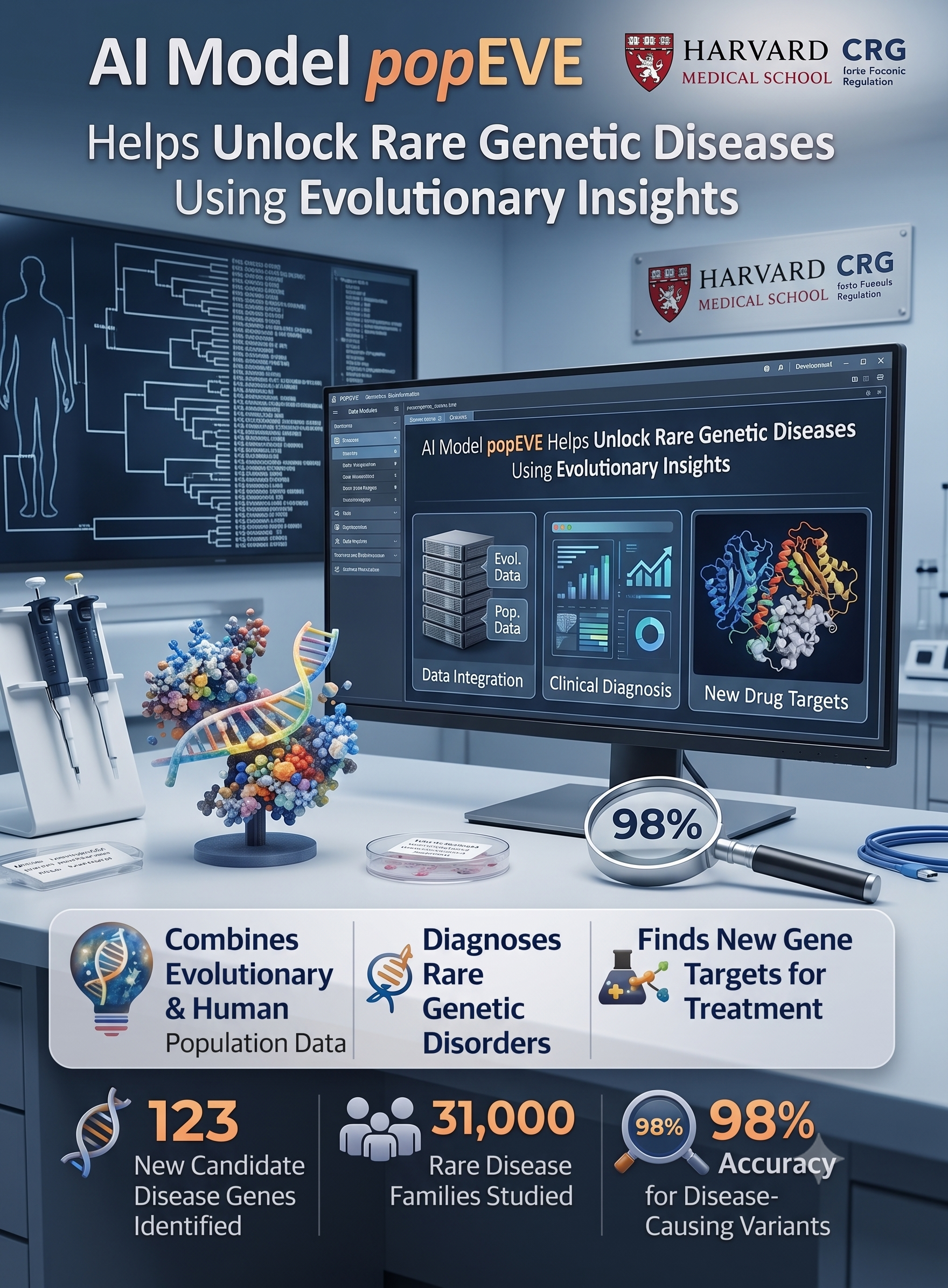
Researchers from Harvard Medical School and the Center for Genomic Regulation (CRG) in Barcelona have developed popEVE, an advanced AI model that predicts the impact of genetic variants across the human proteome. By combining evolutionary information from thousands of species with human population data, popEVE can estimate which variants are most likely to cause disease even in genes that were previously unstudied [1].
“Clinics don’t always have access to parental DNA, and many patients come alone. popEVE can help doctors identify disease-causing mutations, speeding up diagnoses,” says Mafalda Dias, PhD, part of the authors of the study.
popEVE builds on an earlier model called EVE, which analyzed evolutionary patterns to classify mutations as benign or harmful. However, EVE could only compare variants within the same gene, limiting its ability to prioritize which mutations are most dangerous across the genome.
To overcome this, the team enhanced EVE by:
1. Incorporating a protein language model that learns patterns in amino acid sequences.
2. Adding human population data –from sources like the UK Biobank and gnomAD to calibrate predictions.
By combining cross-species and within-species information, popEVE can evaluate how a variant affects protein function and its importance to human health.
The team validated popEVE using data from over 31,000 families with children affected by severe developmental disorders. Key findings include:
•Correctly ranking the causal mutation as the most damaging in 98% of cases where it was already known.
•Discovering 123 new candidate disease genes, many linked to brain development.
•Diagnosing about one-third of previously unsolved cases.
•Demonstrating no ancestry bias, performing well even for patients from underrepresented populations.
popEVE also outperformed other state-of-the-art models, including DeepMind’s AlphaMissense, and can operate with a patient’s genetic data alone, no parental DNA required.
popEVE is already being tested in clinical settings, with collaborations at institutions including Boston Children’s Hospital, Children’s Hospital of Philadelphia, and Genomics England. Clinicians are using the model to interpret variants in patients, accelerating rare-disease diagnoses [2].
“These are the cases where we have to look outside of the known disease genes, and popEVE has already found a lot of gene candidates,” says Rose Orenbuch, research fellow and lead author of the study.
The researchers are integrating popEVE scores into existing variant and protein databases, enabling scientists worldwide to compare variants across genes. In addition to improving diagnosis, the model may help identify new drug targets and guide treatment strategies for rare genetic conditions.
“Prioritizing variants based on predicted disease severity will improve the odds of diagnosis and ultimately pave the way for better treatment and drug discovery,” says Debora Marks, PhD, co-senior author of the study.
Rare diseases affect millions worldwide, yet many patients remain undiagnosed for years. AI-driven tools like popEVE represent a major advance, combining evolutionary insights and human population data to make sense of the genomic complexity. By pinpointing the variants most likely to cause disease, popEVE gives clinicians a roadmap for faster, more accurate diagnoses, improving patient care and opening new avenues for research and therapy.
References:
Proteome-Wide AI Model Supports Rare Disease Diagnosis Using Evolution. November 25, 2025.
Catherine Caruso, H.M.S., New AI model could speed rare disease diagnosis. November 24, 2025.