

Malaria remains one of the world’s most persistent global health challenges, causing hundreds of millions of infections each year, particularly in regions with limited healthcare infrastructure. While the disease is preventable and treatable, accurate and timely diagnosis continues to be a major obstacle. Today, artificial intelligence (AI) is opening new doors to faster, more reliable, and more scalable malaria diagnostics.
One of the most difficult aspects of malaria control is detecting Plasmodium vivax, a parasite that can remain dormant in the human body and cause relapsing infections. Current diagnostic tests rely on parasite proteins such as PvRBP2b, which triggers a strong antibody response and serves as a key biomarker for dormant infection [1].
However, PvRBP2b is notoriously unstable and difficult to produce,limiting its use in real-world diagnostic kits. Recent research has shown how AI-driven protein design can solve this problem. By using computational modeling and deep-learning based sequence generation, researchers engineered stabilized variants of PvRBP2b that maintain their antibody-binding ability while offering higher stability and production yields. Laboratory validation confirmed that these AI-designed proteins behave just like the original biomarker in patient samples, but with far better robustness.
Beyond biomarkers, artificial intelligence is also revolutionizing the way malaria is detected under the microscope. Traditional diagnosis, based on manual examination of blood samples, requires skilled personnel and is prone to human error, especially in high-traffic environments.
Recent studies using deep learning models, particularly convolutional neural networks (CNNs), have demonstrated remarkable accuracy in identifying malaria parasites from blood samples images. Advanced architectures such as Xception and Inception-ResNetV2 have achieved diagnostic accuracies of around 98%, consistently outperforming conventional models [2]. Importantly, these systems remain highly accurate even when tested on independent datasets with different staining and imaging conditions, an essential requirement for real-world deployment.
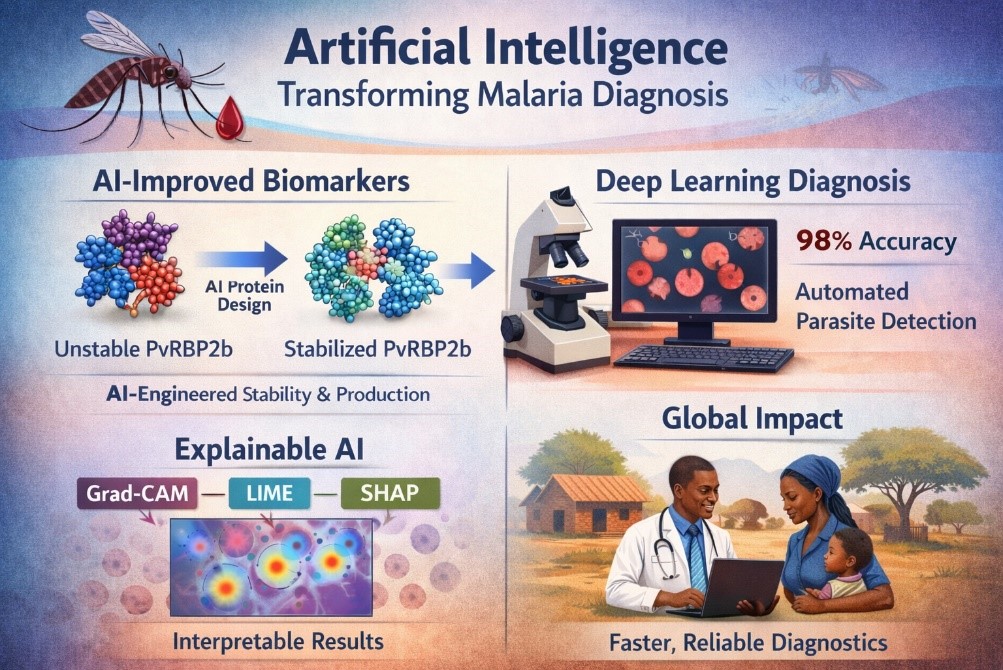
In healthcare, accuracy alone is not enough, clinicians must trust the system. To address this, researchers are increasingly integrating explainable artificial intelligence (XAI) techniques into malaria diagnostics. Tools such as Grad-CAM, LIME, and SHAP allow clinicians to visualize why an AI model made a specific decision, highlighting the exact regions of blood cells that influenced the diagnosis.
This transparency not only builds confidence but also helps identify failure cases, such as staining artifacts or image noise that can mislead automated systems. By combining high performance with interpretability, AI-based malaria diagnostics become safer, more reliable, and more clinically acceptable
From AI-designed biomarkers that improve test stability to deep learning systems capable of near-expert-level diagnosis, artificial intelligence is reshaping malaria detection across multiple fronts. These innovations are especially promising for resource-limited settings, where scalable, automated, and trustworthy diagnostic tools can have the greatest impact. As AI continues to bridge biology, medicine, and data science, it offers a powerful path toward earlier detection, better surveillance, and ultimately, stronger global malaria control.
References:
1) Ulrich, E., AI-designed biomarker improves malaria diagnostics. Oct. 8, 2025.
2. Rahila Parveen , B.Q., Wei Song, Nouf Al-Kahtani, Mona M Jamjoom, Samih M Mostafa, Nadia Sultan, Joddat Fatima Trustworthy deep learning for malaria diagnosis using explainable artificial intelligence. 2025 Dec 19.