
Why AI Breakthroughs Are Happening Now
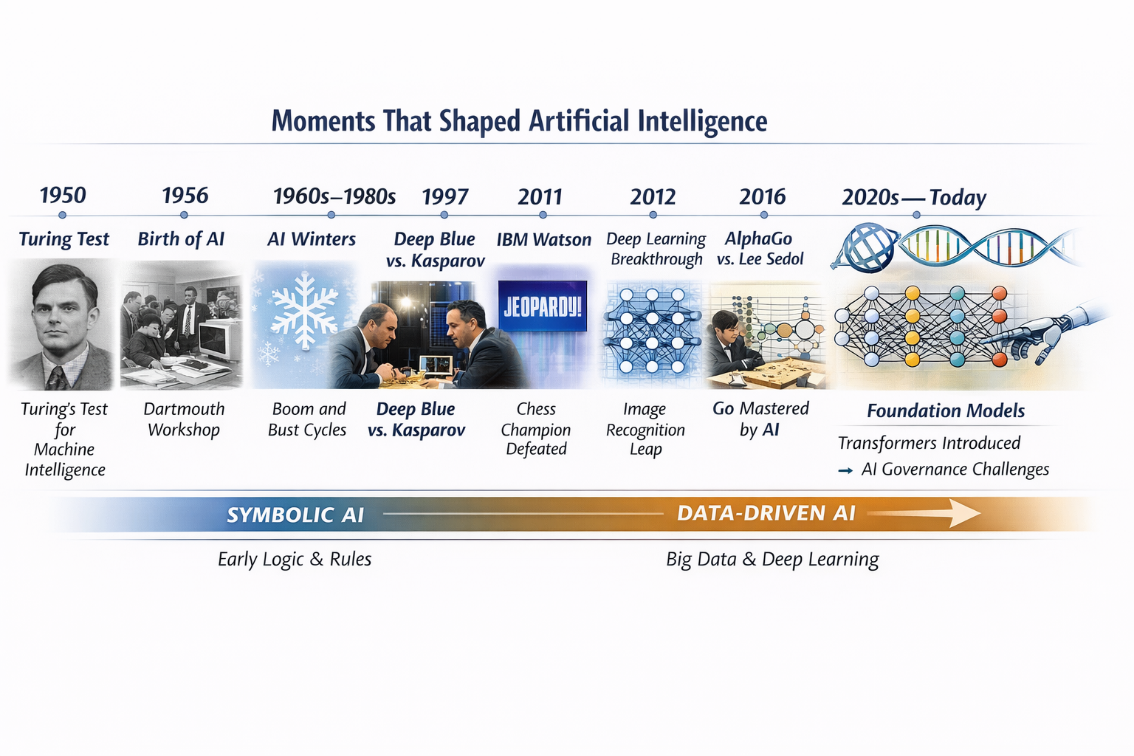
Artificial intelligence (AI) is not new. Coined in the 1950s, the concept went through cycles of early optimism and repeated “AI winters,” when limited computing power and scarce data prevented real-world impact. What has changed is not the idea of AI, but the conditions that allow it to work.
Over the past decade, three forces have converged: massive digital datasets, powerful computing hardware, and learning-based algorithms such as deep learning and transformers. Unlike earlier rule-based systems, modern AI learns patterns directly from data, enabling it to scale, adapt, and generalize. This shift explains why AI can now design antibodies with atomic precision, propose disease mechanisms, guide CRISPR experiments, and automate routine laboratory work. AI has moved from following instructions to modeling biological complexity, marking a genuine turning point rather than another cycle of hype [1], [2]
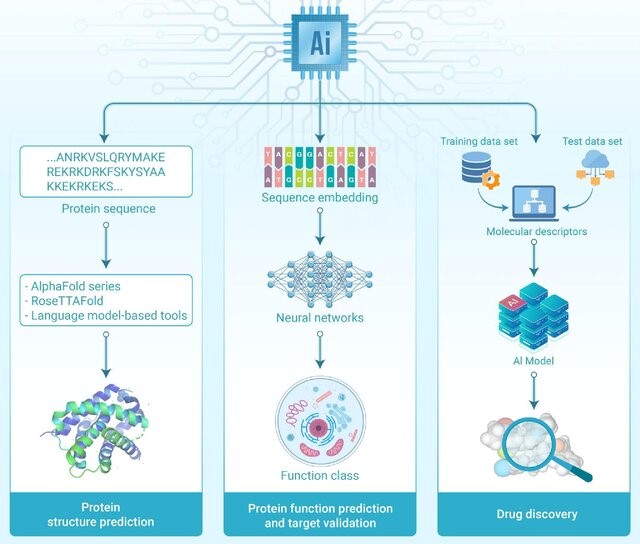
As a result, AI is no longer confined to predicting protein structures or analyzing data after experiments are complete. Across laboratories and clinics, AI systems are increasingly designing molecules, guiding experiments, and supporting routine bench work with expert-level accuracy, accelerating biomedical research and shortening the path from discovery to patients.
From routine lab work to smarter experiments
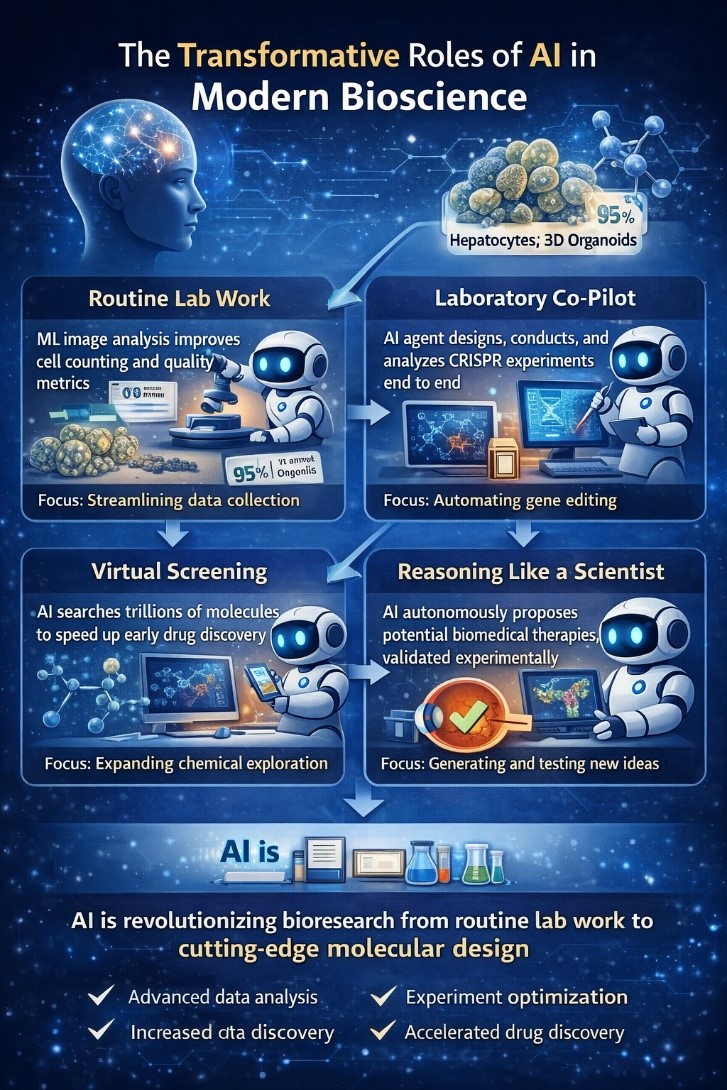
AI’s impact is visible even at the most basic experimental level. Machine learning (ML)–based image analysis is improving the counting of complex cell models such as hepatocytes and three-dimensional organoids, tasks that have long challenged both manual methods and conventional automated platforms. By recognizing subtle morphological patterns, ML-enabled systems can distinguish target cells from debris, clumps, and contaminants, while reporting quality metrics such as viability and organoid size. The result is greater reproducibility and less time spent on routine measurements, freeing researchers to focus on biological insight [3].
AI as a laboratory co-pilot
AI is also lowering the barrier to advanced experimental techniques. In gene editing, CRISPR-GPT acts as an agentic laboratory assistant that designs, troubleshoots, and analyzes CRISPR experiments end to end. Reported in Nature Biomedical Engineering, the tool enabled first-time users to achieve up to 90% gene-editing efficiency, performance typically associated with experienced laboratories. By translating natural-language prompts into step-by-step protocols and real-time troubleshooting, CRISPR-GPT demonstrates how AI can function as a hands-on experimental partner, improving reproducibility while reducing costly errors [4].
Exploring chemical space at unprecedented scale
At the earliest stages of drug discovery, AI is dramatically expanding what scientists can search. AI-driven virtual screening enables three-dimensional searches of trillions of drug-like molecules, transforming chemical exploration from millions to vastly larger candidate spaces. This scale was unimaginable just a few years ago and is accelerating early-stage discovery by uncovering diverse chemical matter far faster than traditional approaches [5], [6].
When AI starts thinking like a scientist
AI is also beginning to move beyond tools and into reasoning. In a recent study, an AI system named Robin autonomously proposed a potential treatment strategy for dry age-related macular degeneration, a leading cause of vision loss with no approved therapy. By combining literature mining, hypothesis ranking, and experimental planning, the system identified a disease mechanism and suggested repurposing an existing drug—predictions that were later validated experimentally. While experts caution that AI does not replace human judgment, the work highlights its growing ability to synthesize knowledge across disciplines and rapidly generate testable ideas [7].
Designing biology with atomic precision
Perhaps the most striking advances are occurring at the molecular level. Researchers recently demonstrated that AI models can design full-length antibodies from scratch with atomic-level precision. Experimental validation using cryo-electron microscopy confirmed accurate binding to viral, bacterial, and cancer-related targets. Although these designs are not yet clinically ready, the work signals a shift from screening existing molecules to designing therapeutic proteins in silico, opening new possibilities for targeting traditionally “hard-to-drug” proteins [8].
A broader transformation underway
Taken together, these advances reflect a deeper convergence of biology and computation. Generative AI, large foundation models, and multimodal biological data are transforming discovery across scales—from cell counting and gene editing to drug design and disease modeling. The result is a gradual shift toward predictive, personalized, and preventive medicine [9].
Scientists emphasize that AI is not replacing researchers. Instead, it is redefining roles: machines handle scale, complexity, and iteration, while humans provide interpretation, creativity, and ethical oversight. The integration of AI into everyday laboratory infrastructure is quietly driving what may be one of the most consequential shifts in biomedical research in decades [10], [11].
References:
[1] S. C. Institute, “History of Artificial Intelligence.” [Online]. Available: https://swisscyberinstitute.com/blog/history-artificial-intelligence/. [Accessed: 01-Feb-2026].
[2] European Commission, “JRC TECHNICAL REPORTS AI Watch Historical Evolution of Artificial Intelligence Analysis of the three main paradigm shifts in AI,” 2020.
[3] L. Bai, Y. Wu, G. Li, W. Zhang, H. Zhang, and J. Su, “AI-enabled organoids: Construction, analysis, and application,” Bioact. Mater., vol. 31, no. September 2023, pp. 525–548, 2024.
[4] Y. Qu et al., “CRISPR-GPT for agentic automation of gene-editing experiments,” Nat. Biomed. Eng., pp. 1–24, 2025.
[5] C. Gorgulla et al., “AI-Enhanced Adaptive Virtual Screening Platform Enabling Exploration of 69 Billion Molecules Discovers Structurally Validated FSP1 Inhibitors,” bioRxiv (The Prepr. Serv. Biol., 2025.
[6] G. Zhou et al., “An artificial intelligence accelerated virtual screening platform for drug discovery,” Nat. Commun., vol. 15, no. March, pp. 1–14, 2024.
[7] A. E. Ghareeb et al., “ROBIN: A MULTI - AGENT SYSTEM FOR AUTOMATING SCIENTIFIC DISCOVERY,” arXiv:2505.13400, pp. 1–30, 2025.
[8] N. R. Bennett et al., “Atomically accurate de novo design of antibodies with RFdiffusion,” bioRxiv Prepr. doi, 2025.
[9] P. Song et al., “Artificial intelligence-enabled digital biomedical engineering,” BMEMat Wiley, vol. 3, pp. 1–33, 2025.
[10] M. E. Eren and D. M. Perez, “Rethinking Science in the Age of Artificial Intelligence,” arXiv:2511.10524v1 [cs.AI], 2025.
[11] M. Luo et al., “Artificial intelligence for life sciences: A comprehensive guide and future trends,” Innov. Life, vol. 2, no. 4, pp. 1–30, 2024.