

When someone arrives at the hospital with chest pain, doctors use an electrocardiogram (ECG) to check for signs of a heart attack. In many cases, this works well, a distinctive pattern in the reading, called ST elevation, immediately signals the most serious type and prompts emergency treatment. But for a significant group of patients, this pattern simply doesn't show up.
These cases, known as occlusive myocardial infarction (MI) without ST elevation are some of the hardest to diagnose quickly. Without a clear ECG signal, doctors must wait for additional blood tests and sometimes more invasive investigations before confirming a blockage. That wait can cost precious time, and in a heart attack, time is muscle.
What the Study Found?
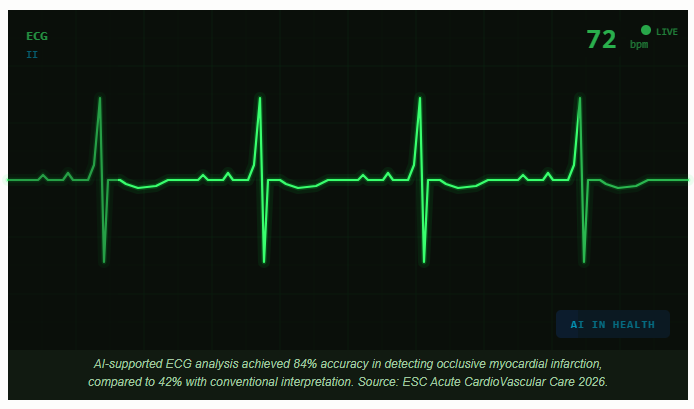
New research presented at ESC Acute CardioVascular Care 2026, run by the European Society of Cardiology, suggests that AI could close this diagnostic gap. The study followed 1,490 patients who came in with suspected heart problems. Each patient's ECG was reviewed in the usual way by clinicians and analysed separately by a CE-certified AI algorithm running on a smartphone. The results were striking. Standard clinical ECG interpretation correctly identified occlusive MI in just 42% of cases. The AI achieved an accuracy of 84%, with a particularly high ability to rule out a heart attack, its negative predictive value was 98%, meaning it almost never missed a case that wasn't there.
Part of a growing trend
This study is one of a growing number pointing to AI's potential role in cardiovascular care. In a separate development, researchers at the Mount Sinai Kravis Children's Heart Centre have developed an AI model that uses ECG readings to identify which children who have had surgery for a congenital heart condition called tetralogy of Fallot might need follow-up MRI scans. By learning to spot subtle changes in the ECG that correlate with shifts in heart structure and function, the model could help prioritise patients who truly need scarce MRI capacity without replacing the scan itself. Together, these studies reflect a broader shift: AI is increasingly being seen not as a futuristic novelty, but as a practical support tool in the everyday diagnosis and management of heart disease. The topic will be a central theme at ESC Congress 2026 in Munich later this year.
References:
ICT&health: AI improves detection of hard-to-diagnose heart attacks https://www.icthealth.org/news/ai-improves-detection-of-hard-to-diagnose-heart-attacks Published: 30 March 2026
European Society of Cardiology: ESC Acute CardioVascular Care 2026 press release https://www.escardio.org/news/press/press-releases/acvc-press/