

Imagine managing diabetes without the daily finger pricks. For millions of people worldwide, checking blood sugar is a routine full of discomfort, but new research is bringing a pain free alternative closer to reality.
Researchers at MIT, led by Jeon Woong Kang, are pioneering a technique that measures blood glucose through intact skin using a method called Raman spectroscopy. By shining near-infrared light onto the skin, the device detects tiny vibrations in glucose molecules. These signals can then be translated into blood sugar readings all without drawing a drop of blood [1].
Previously, the team tested this approach on animals, successfully monitoring glucose levels through pig skin. Now, their refined device is compact about the size of a shoebox and accurate enough to track human glucose levels in real time. In trials, the device detected blood sugar spikes in a volunteer as he consumed sugary drinks, matching the performance of traditional finger-prick monitors.
“Most patients under-test their blood glucose because finger pricks are painful,” says Kang. “Our goal is to make monitoring simple, safe, and comfortable.”
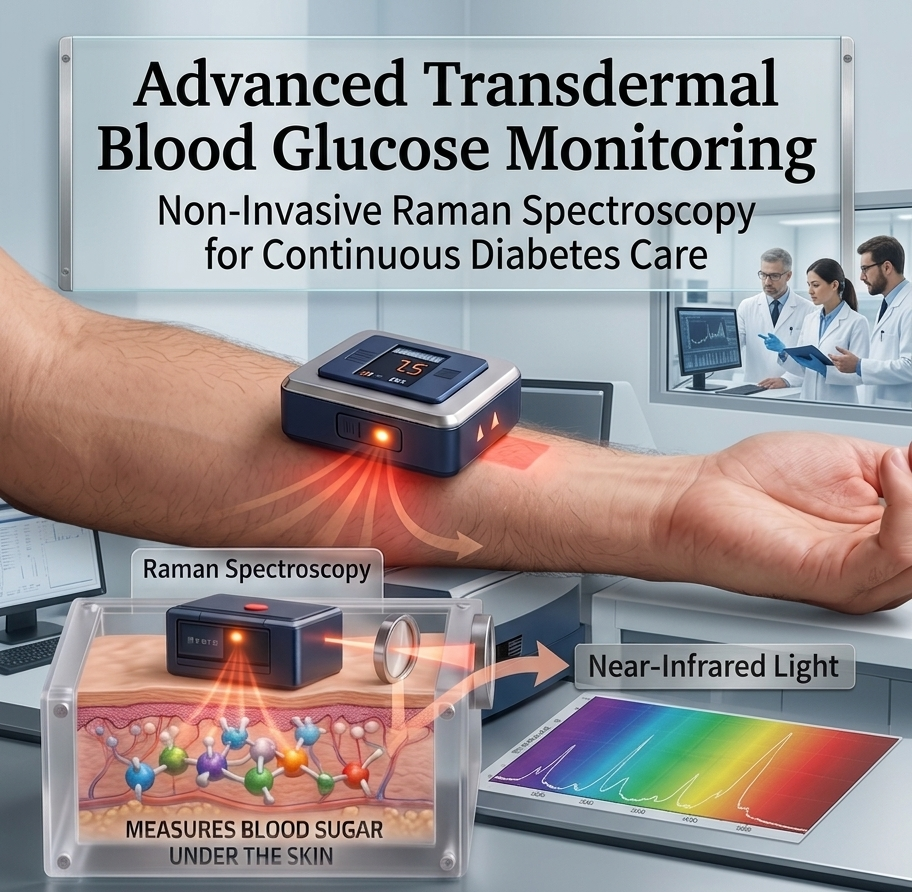
Another study, published by Al-Jammas et al., explored near-infrared (NIR) spectroscopy for non-invasive glucose tracking. Their device, which uses a fingertip sensor and a tiny photodetector, converts light readings into glucose concentrations using gender-specific calibration models [2].
• Accuracy: over 80%
• Precision: over 91%
• Cost: under $25
The system is lightweight, portable, and displays results on a clear OLED screen, allowing patients to monitor their glucose levels at home without specialized training. The need for painless glucose monitoring is urgent. According to the International Diabetes Federation (IDF), over 537 million adults had diabetes in 2021, a number expected to rise to 853 million by 2050. Non-invasive monitoring could:
•Reduce discomfort and infection risk from frequent finger pricks
•Encourage more regular testing and better disease management
•Provide real-time feedback for timely interventions
Scientists are now working to improve the technology further. Goals include:
•Miniaturizing the devices into wearable formats
•Ensuring accurate readings across different skin tones, ages, and health conditions
•Incorporating multiple wavelengths of infrared light for even better precision
With these advances, monitoring blood sugar could become as easy as wearing a watch, transforming daily life for millions of people living with diabetes.
References:
Khedkar, S., Measuring Blood Sugar Without Painful Pricks? A New Test Scans Skin. Dec 8, 2025.
Jerome Workman, J., New Infrared Device Measures Blood Sugar Without a Prick. September 11, 2025.